Getting started#
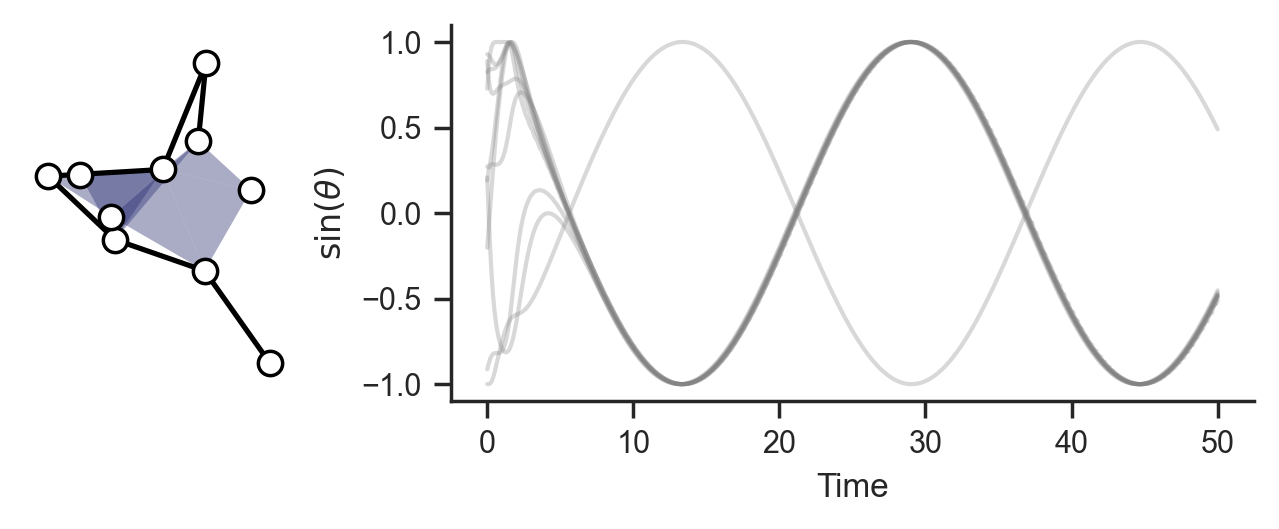
Here is a minimal example simulating Kuramoto oscillators with pairwise and triplet interactions on a random hypergraph:
import matplotlib.pyplot as plt
import numpy as np
import xgi

import hypersynchronization as hs

N = 10 # number of nodes
rng = np.random.default_rng(42) # random seed for reproducibility

# generate hypergraph
H = xgi.fast_random_hypergraph(N, ps=[0.1, 0.05], seed=rng)
links = H.edges.filterby("order", 1).members()
triangles = H.edges.filterby("order", 2).members()

# set dynamics parameters
k1, k2 = 3, 1
omega = rng.normal(0.2, 0.1, N)
theta_0 = hs.generate_state(N, kind="random", seed=rng)

# simulate dynamics
thetas, times = hs.simulate_kuramoto(
    H,
    omega=omega,
    theta_0=theta_0,
    t_end=50,
    dt=0.1,
    rhs=hs.rhs_23_sym,
    integrator="RK45",
    args=(k1, k2, links, triangles),
)

# visualize results
fig, (ax1, ax2) = plt.subplots(
    1, 2, width_ratios=[1, 3], figsize=(5, 2), layout="constrained",
)

# draw hypergaph
pos = xgi.barycenter_spring_layout(H, seed=20)
xgi.draw(H, ax=ax1)

# draw timeseries
hs.plot_series(thetas, times, ax=ax2, alpha=0.3)

sb.despine()
plt.show()